OK, 7:40 PM showing of Moneyball: entertain me & I'll promise not to audibly pick apart every inaccuracy for everyone in the theater. Deal? -- from my Twitter feed, September 24.
Through the eyes of the team's fans, the cinematic adaptation of Michael Lewis' polarizing 2003 bestseller could inadvertently serve as a metaphor for the current Oakland Athletics ballclub. That is to say I enjoyed the film, but I don't know if I could recommend it to a larger audience.
The 2011 Athletics were one of the most disappointing and depressing teams I've followed in my 30 years as an A's fan. But, they have a rookie second baseman named Jemile Weeks who was absolutely electrifying for long stretches after he was called up in June. On a squad without much crossover appeal or charisma, Weeks' flashiness out of the leadoff spot -- at the plate and on the basepaths -- was impossible to miss and easy to embrace.
In Moneyball, Brad Pitt is Jemile Weeks.
Well, actually, Pitt plays Oakland Athletics general manager Billy Beane. (But, stick around...I'll make the Weeks comparison work.) Moneyball opens with excruciating highlights from the fifth and final game of the 2001 American League Division Series. After winning the first two games against the mighty Yankees in New York, the A's would lose the next two at home in Oakland before dropping the clincher back in the Bronx. Faced with the expected loss of several free agents, Beane assumes the herculean task of replacing now-expensive offensive productivity at a fraction of its price on the open market.
I'm incredibly torn on Brad Pitt's performance. The film leans heavily on his incandescent charm -- particularly during the glacially-paced first 30 minutes -- and Pitt deftly softens Beane's more egocentric moments to the point where you just know he's right and everyone else is wrong, wrong, wrong. During the much-discussed "scout scene", Pitt's Billy Beane condescendingly shoves his new-school methods down the collective throats of his scouting staff -- who are practically depicted as cardboard cutouts from the Mesozoic Era. It's ham-fisted in its subtlety, but Pitt has perfected the concept of patter and sharpens the scene's bluntness to a slightly finer point.
There are other moments in Moneyball when Brad Pitt seems to be playing...Brad Pitt. During a pair of otherwise entertaining scenes, Beane is frantically working the phones -- several lines at a time -- in hopes of closing several trades. Here -- as the fast-talking, junk-food fueled snake-oil salesman -- a straight line could be drawn from Moneyball to Ocean's 11 to every late-night talk show appearance Pitt has ever made.
The supporting cast, thankfully, is much more consistent in their performances. Jonah Hill is fantastic as Beane's right-hand man Peter Brand. He's an insecure numbers-cruncher who grows into his skin before our eyes. In one of the film's best scenes, Brand is tasked with informing hotshot prospect Carlos Peña that he's been traded from Oakland to Detroit. It's an odd segment played as one long, awkward pause -- curiously, there are a LOT of those in this movie -- but, it's only briefly uncomfortable as Hill controls the moment.
In smaller roles, Philip Seymour Hoffman convincingly turns affable then-A's manager Art Howe into a seething, simmering pot of distrust and insecurity as he defies Beane -- and his dorky statistics -- at every turn. Meanwhile, Chris Pratt is solid as Scott Hatteberg -- the team's new first baseman who was one of the faces of the Moneyball era. (Although, his character's challenges and concerns with learning a new position are never really paid off in the film.)
Ultimately, all of the actors gamely lift Moneyball onto their shoulders, but fall short of bringing it all together.
The first quarter of the film remains stuck in first gear and just when it starts to build some momentum, the script slows it down again. There are a handful of flashbacks to Beane's own failed Major League Baseball career that actually work as a foreshadowing element, but they're still a bit clunky in execution. A scene where Beane picks up his 12-year-old daughter at the home of his ex-wife is downright mean in its depiction of his ex's new husband -- played as an emotionally and physically feeble spirit who knows nothing about sports, as if this were an overt character flaw.
Moneyball does, of course, build towards its obligatory climactic sports moment. Kind of. After a lot of mediocrity, the Oakland A's start winning...all the time. Real footage from the team's supersized 2002 winning streak is interspersed towards the end of the final act until we're back...at a regular season game in September. The A's take an 11-0 lead and are well on their way to winning their 20th straight until it all falls apart. It actually works as drama, though, thanks in part to a fleeting, dialogue-free moment from Hoffman who nails the epiphany scene that could've easily been played as paint-by-numbers. Instead, it's as close as we get to a confluence between the film's true protagonists: old-school instincts and new-school statistics.
But, since this is a baseball movie and Brad Pitt isn't playing a baseball player, the final sequence creaks to the finish line. Pitt furrows his brow and runs his hands through his hair in exasperation as Beane watches the climax unfold from the front row. In 2002, I watched this game from my living room. It was one of my favorite experiences as a sports fan. It almost certainly meant much less to you, though, which is why the final, final scenes are of a conflicted Beane as he ponders a more lucrative job offer.
Moneyball doesn't entirely succeed as a "something for everybody" film, but it comes closer than many of the more critical reviews would have you believe. Like the 2011 Oakland Athletics fed off of the frenetic, high-wattage energy of Jemile Weeks, Pitt's leadoff leading man performance here is strong enough to fuel Moneyball even during its slower moments. Again, I enjoyed the film as a whole and would absolutely see it a second time, but the subject matter spoke to me in a way that it might not to you.
Which is why you probably haven't heard of Jemile Weeks. Yet.
Off to see Green Lantern. The comic book geek in me is REALLY rooting for this to be good. Every critic in the country can be wrong, right? -- from my Twitter feed, July 8
I'll admit it...I'm biased.
I grew up reading DC Comics and watching the Saturday morning and syndicated cartoons featuring their superhero characters. As far back as I can remember, Batman was always my favorite with Green Lantern firmly established as the silver medalist. Superficially, it was easy to understand Green Lantern's appeal to us comic book kids. He could fly (fantasy!), he could create anything with his ubiquitous power ring (imagination!) and...well, we didn't need much else in the early 1980s.
Of course, I'm oversimplifying the guy. The Green Lantern character was part of a seminal sociopolitical story arc in the 1970s and written in ways throughout the 1980s/1990s that mined many more mature plots. The character's inherent problem, however, is that ALL comic book superheroes are oversimplified to some degree. Superman? He's the guy with all those powers. Flash? He runs really fast. Spider-Man? Spider, man. Green Lantern? He's got...a ring.
In the build-up to the theatrical release of Green Lantern, non-fans who'd never heard of this admittedly second-tier superhero derided the character's obvious absurdities such as the ring thing and the "Green Lantern" appellation. Oh, and the oath. My favorite diss came from my friend Joe Reid who wrote at his Low Resolution blog:
"... the more I see about the mythology and the aliens and Ryan Reynolds intensely reciting that 'neither rain nor sleet nor glowing-green snow' credo -- I guess I'm really drawn to un-gritty comic book movies this summer."
The film was released on June 17 and despite pulling in more than $150 million in worldwide box office receipts, the critical consensus was "meh". And, that's probably being kind.
But, as I said, I'm biased. I liked it.
Many of the reviews I read appeared to have an ax to grind with Ryan Reynolds -- for his past sins on Two Guys, A Girl and a Pizza Place, I presume. But, as the title character, he does what he can with a haphazard script and some especially creaky dialogue. In the opening aerial sequence, his Hal Jordan test pilot alter-ego plays as a campy mishmash of ham and bravado. He "freezes up" while flashing back to memories of his late father. It actually reminded me of Charlie Sheen as Lt. Topper Harley in the 1991 Top Gun spoof, Hot Shots.
Reynolds spends the first and second act going through the standard superhero movie motions (discovers power, doesn't know what to do with it, makes public debut by saving something/someone), but he brings it together for the film's choppy -- but, effective -- final act. Let's be honest: he's riding shotgun with a mystical piece of jewelry. Some of the film's most crowd-pleasing moments involved a giant green toy racecar track and a bad-ass green machine gun.
The film's lack of structure keeps any chemistry from developing between Reynolds and Blake Lively, who plays Carol Ferris -- Hal Jordan's love interest. She's even less convincing in the cockpit than Reynolds during the first scene, but the character is written in way that seemingly keeps her one step ahead of the superhero at all times. (She figures out Green Lantern's secret identity in short order with a clever little line about cheekbones.) Reynolds and Lively just never click, not even during the obligatory damsel-in-distress moments.
So, what did I like? Well, there's Peter Sarsgaard as the psionic villain Hector Hammond. Before Hammond's eventual corruption, Sarsgaard plays him with a gentle hand. The restrained enthusiasm he exhibits during his autopsy of an alien corpse is a hoot and Sarsgaard pairs it with a simmering bitterness just under the surface. The full-on transition to big-brained bad guy doesn't work nearly as well. (Similarly, the build up for the primary antagonist, Parallax, is much better than the payoff.) Mark Strong plays Jordan's distrusting mentor Sinestro with a warrior's nobility and, though it was woefully underdeveloped, the fanboy in me squealed with glee at the conceptualized mythology of the Green Lantern Corps.
The film never ascends anywhere close to greatness, but Green Lantern was actually a lot of fun. It moves in fits and starts, hastily blowing through developments that seem kinda-sorta important (near as I can tell, Jordan is formally trained by the Green Lantern Corps for two or three minutes) on its way to pay lip service on more serious matters (wait, the good guys are willing to sacrifice planet Earth to save themselves?) Reynolds makes for a likeable hero with just enough self-awareness to make the whole thing seem comic-book believable.
Now, the comic book geek in me is REALLY rooting for a sequel.
A puzzling little action film from director Duncan Jones, Source Code stars Jake Gyllenhaal as Captain Colter Stevens. His character is that rare military-trained cinematic protagonist who's not written as some sort of G.I. Joe caricature. Rather, Capt. Stevens awakens within the body of another man and -- not surprisingly -- freaks the f*** out.
He soon learns that a bomb has been detonated on a Chicago commuter train and he's been sent back in time to the exact same train -- eight minutes before it inevitably explodes -- to identify the bomber and stop him from unleashing further terrorist attacks on the city. Each time Capt. Stevens fails in his mission, he's sent right back to the train by a technologically-advanced, morally ambiguous Government agency with the same "eight-minutes-to-save-the-world" window.
Gyllenhaal is surprisingly believable as Capt. Stevens, who is kept in the dark -- figuratively and literally -- with regards to the handlers of his puppet strings. Early on, the battle-tested soldier is sloppy and paranoid as he chases red herrings, assaults anyone who looks at him sideways and struggles with the notion of saving hundreds of passengers who are, presumably, already dead.
Michelle Monaghan plays Christina Warren -- the would-be love interest of the man Capt. Stevens is trapped inside. (I know, I know...but, it works.) Appropriately, she's more confused than suspicious when her good friend -- a mild-mannered teacher, as far as she knows -- races back and forth and occasionally off the train in his pursuit of the bomber. The supporting cast is rounded out by Jeffrey Wright -- his Dr. Rutledge created the classified "Source Code" mission -- and Vera Farmiga, who does what she can with her role as Lt. Goodwin, the mission liaison between Dr. Rutledge and Capt. Stevens.
Source Code checks in at just over 90 minutes and moves along briskly enough. Yes, there's the obligatory plot twist, some shocking revelations about the shadowy agency Capt. Stevens works for and an oddly-timed exposition that arrives after 45 minutes of consistent stonewalling. The film's premise drains some of the tension out of the climactic sequence, but that point is recognized and turned into a satisfying conclusion.
I can understand the criticism that the film's final few scenes felt like they were tacked on after the initial test screenings, but the finish line actually enhanced the investment into the characters, plot and endearingly creaky dialogue ("One soldier to another...am I dead?")
Ms. Yvonne -- professionally known as "That Mexican Wife" -- writes:
OK - I haven't been reading you as long as most TBG aficionados so I hope you'll forgive my ignorance. I really do get most of your jokes (even the wrestling ones!) but for the life of me I can't figure out what "General Haberdashery" means. Little help?
Prepare to be disappointed, Yvonne. It means...nothing. I lifted it from an episode of King of the Hill. Chris Rock had a guest spot as the voice of a stand-up comedian who worked at a traffic school and used the line, "Now that's what I call 'general haberdashery'!" It was a ridiculous non sequitur that became my title for the weekly links section of my old Friday music news column and carried over to TBG.
Today, I use it to highlight the work of my former online colleagues -- especially when I'm busy working on a certain annual month-long feature that's scheduled to start in about a week.
---
It's Oscar season and Mrs. Bootleg's favorite blogger -- wait, what...? -- is cranking out the cinematic material. Movie Joe Reid walks you through the best trailers of the year, his 30 most amazing movie moments of 2010 and an excellent look back -- in hindsight -- at Academy Awards handed out in 1990, 1995 and 2000. Would it be inappropriate to mention how much I hated Gladiator or that I've never seen The Usual Suspects or how I still get choked up during Ghost? It would? Well, then.
I'm a sucker for "travel diaries" and m'man Daniels spins a terrific lil' tale of 34-ounce steaks, Atlantic City casinos and suffering through the Super Bowl...in standard definition.
My friends at 85% Sports have been quietly crafting one of the more intelligent and thorough sports blog you'll see. Their NFL Offseason Series is terrific, as are their MLB Positional Rankings. And, check out the biggest St. Louis Cardinals fan on the planet as he's forced to deal with the Albert Pujols negotiationsdiscussions stuff in real time.
Finally, the crew at Fish & Spaghetti revisit one of my all-time favorite TV shows with a face-off of two former inmates at the Oswald State Correctional Facility. I'm with 'em on each and every point -- even though Ryan O'Reily's short-lived, ironic stint on Law & Order: SVU is completely ignored.
"Once in a great while, we are privileged to experience [an] event so extraordinary, it becomes part of our shared heritage." -- Krusty the Clown, February 9, 1997
When I was a boy, pop culture was my unofficial stepparent. Back then, only two events (title fights in boxing and made-for-TV miniseries) regularly generated the kind of squealing media hype that now precedes even the least attractive Armenian-American celebrity.*
* -- Oh, come on. Khloe Kardashian digs have been done to death. I assumed the universe had moved on to mocking Nicki Minaj, no?
Off the top of my head, I can think of three experiences -- one each in movies, sports and music -- when the hype was truly worth it.
Return of the Jedi -- Time has not been kind to much of the Star Wars franchise, but almost 30 years later, I still remember leaping off the couch when I saw the first Jedi TV spot -- on a Saturday night, in between new episodes of Diff'rent Strokes and Silver Spoons. Yes, the scatological nonsense and intrusive Ewoks have ruined the movie for me today; but in 1983, my brother and I saw Jedi at least 20 times -- back when sneaking into a movie was a cute and acceptable crime, like cocaine or hitchhiking.
1989 Oakland A's -- The '88 A's were the first baseball team I ever loved and the first one to break my heart. (A few years later, I was dumped twice by the same girl in a span of 10 days and it didn't hurt anywhere near as much as Oakland's stunning upset loss to the Los Angeles Dodgers in the World Series.) In 1989, the A's were near-unanimous favorites to win it all. They withstood an array of early injuries, fought off a feisty Angels squad and re-acquired my all-time favorite player on the way to winning the World Series. Thankfully, I'm still on my first marriage and only have one child, so the A's championship still fits into the top five favorite moments of my life.
Doggystyle -- Snoop Dogg's debut album was a big deal. Gangsta rap was at its apex and still popular enough to ward off conservative critics and threats of censorship. Snoop stole the show on Dr. Dre's The Chronic album and his mid-1993 murder charge arguably boosted his profile. I've told the story before, but I waited in line outside V.I.P. Records in Long Beach -- on Crips n' Bloods Martin Luther King Boulevard -- for the midnight release. Today, I might be the oldest man alive who still has this album in regular iPod rotation.
Conversely, these are three of my experiences when the hype greatly exceeded the end result.
Star Wars: The Phantom Menace -- After two hours of stilted dialogue about trade disputes and an endless parade of transparent, broadly-drawn aliens-as-ethnic caricatures, I swore off the franchise for good. My personal protest has even extended to the adult-friendly, kid-intended cartoon versions that currently air. Those who really know me know this isn't an insignificant snub.
1990 Oakland A's -- This squad was the first real "rock star" baseball team back in the early days of the "ESPN-ification" of sports. After winning it all the year before, the experts labeled the A's as a budding dynasty. They were swept right out of the World Series and spent most of the decade as one with the walking dead.
Get Rich or Die Tryin' -- For me, the 50 Cent phenomenon got as far as the first single from his debut album. Get Rich… moved almost a million units in its first week of release in 2003 (and more than 15 million copies to date), but despite some decent beats, 50's uncharismatic mumbling lost me almost immediately.
So, which side of the hype will Five Guys fall?
Here in California, In-N-Out Burger is considered the gold standard for fast food hamburgers. Most of y'all know my position: In-N-Out makes a perfectly acceptable double cheeseburger, but it doesn't belong in any "best of" discussion. This opinion is in direct conflict with tourists and locals alike who believe the ubiquitous Double-Double is a sacri-licious religious experience.
Thanks to the magic of social media, I've been able to eat vicariously through friends and strangers. I first heard of Five Guys from either a Facebook post of an acquaintance living in one of the Mid-Atlantic States or perhaps a random tweet from some national baseball beat writer who blissfully ignores four of MLB's six divisions.
It didn't take long for me to realize that the Five Guys hype rivaled In-N-Out's. It did, however, take a long time before I was able try Five Guys. There wasn't a location in San Diego County until about six months ago. And, apparently, I was one of the last San Diegans made aware of this.
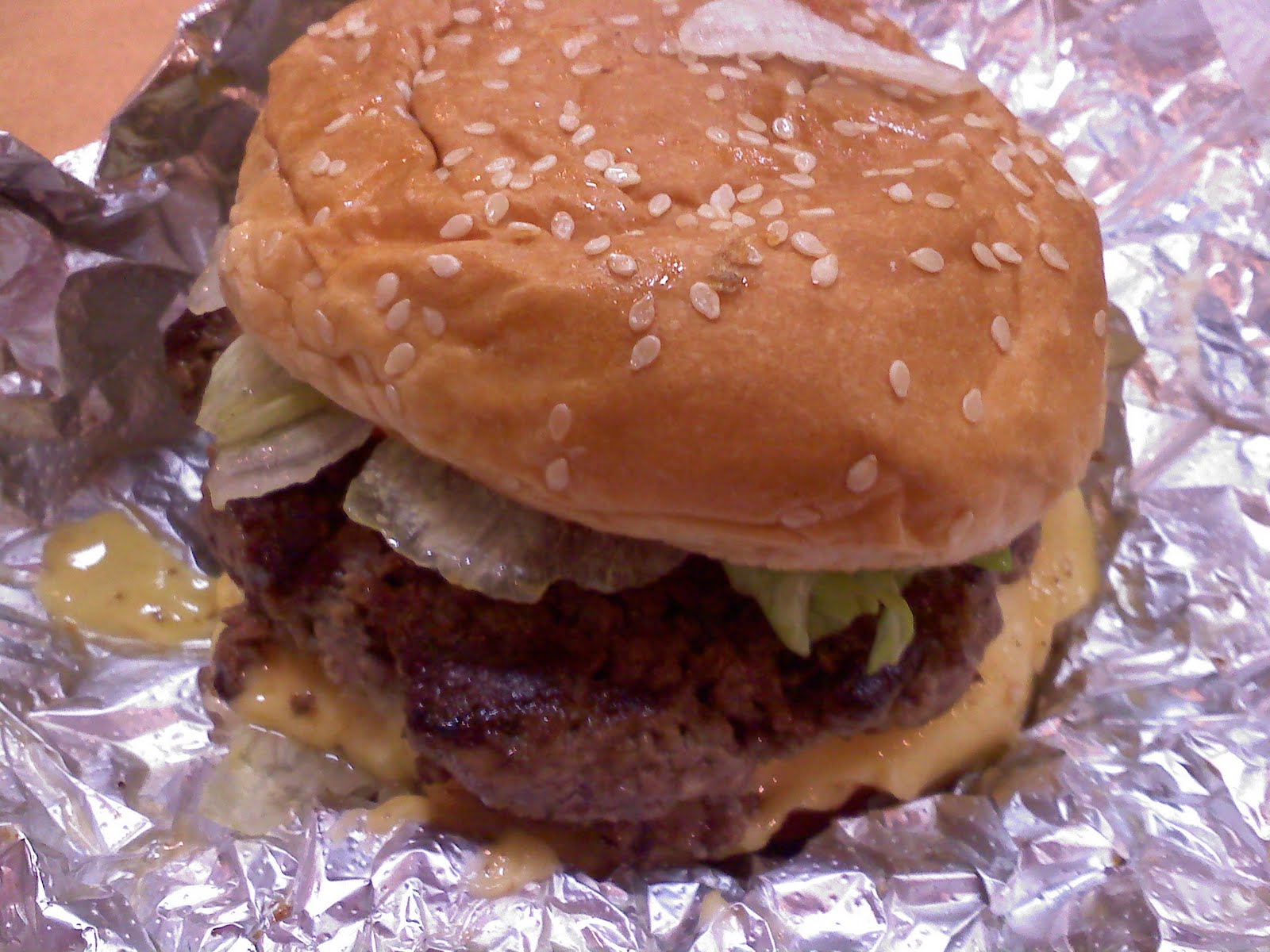
So, I brought That Bootleg Family down to Five Guys. After quickly familiarizing myself with the limited menu, I ordered a bacon cheeseburger with lettuce, tomatoes, grilled onions, ketchup and mayo. Mrs. Bootleg -- in keeping with her long-standing tradition -- waited until I'd begun ordering before she took her very first look at the menu. She extended the palms of her hands and slowly shook her head -- pantomiming perfect confusion -- before hurriedly blurting out, "Little Hamburger with...grilled onions and...ketchup?" Yes...in the form of a question. Two regular orders of fries and a plain Little Hamburger for Jalen finished the order.
After my first bite, I was a believer. The loosely-packed meat oozed juices down my chin and into my nattily-groomed goatee. Meanwhile, the texture of the hamburger -- nicely pebbled without any rigidity -- was homemade, hand-made quality. The smoky-sweet grilled onions contrasted nicely with the lettuce and tomatoes AND subtly accented the meat. Two minor nits: (1) the two slices of cheese might be one too many, as the flavors were suffocated by my last few bites and (2) there didn't seem to be much bacon on my burger (or the other toppings overwhelmed what was there). Jalen finished his hamburger in about six seconds, while Mrs. Bootleg -- in between bites that belied her diminutive stature -- was trying to decide if the Five Guys burger was the best or second-best she's ever had.
I've been sitting on a 4.5 score, steadfast in my refusal to go all in with a perfect five. But, I can't remember the last time I've wanted to return to a restaurant as much as I'm jonesing for an encore at Five Guys. I think that's worth an extra half-point. And, I won't even decrement them for their so-so fries.
My former weekend neighbor on the music news beat has two new posts over at his Lousy Reviews blog. Jeff Fernandez takes on Taco Bell's Beefy Crunch Burrito -- an experience that was apparently less positive than mine -- and Jack in the Box's new Chorizo Chili Cheesy Fries.
(I noticed the "Cheesy Fries" advertisement poster hanging in the window of my local Jack in the Box, but didn't realize there was a "...with chorizo chili..." option. See you soon, Jack.)
My friends over at Fish and Spaghetti introduce the universe to high-end tortilla chips and a Ben & Jerry's flavor that might be delicious, but can't hold a candle to their Oatmeal Cookie Chunk.
Michael Melchor and I go way back to the 411mania.com days, so I couldn't be more pleased to see him still writing about music. This piece on the intersection of nerd culture and music is gloriously geek-tastic.
Daniels and the One New York Life blog have "...an unnatural hatred for Gwyneth Paltrow". I assume he also hates America.
85% Sports explores the idea of St. Louis Cardinals first baseman Albert Pujols pulling down $150 million...per season! It might've been a typo, but I'm pleased to report I caught before he did.
Finally, m'man Movie Joe Reid has the second part of his Spring Movie Preview up on the Low Resolution blog. Bashing Nic Cage? Yup. Kitschy love for an '80s soundtrack? Yup. Un-ironic use of "ridonk"? Oh, f*ck yup!
It appears that most – if not all – of my previously archived work from my three-year run as a weekly columnist and features writer on the Inside Pulse pop culture website has fallen off the grid. That's as good an excuse as any to hunt through my hard drive for retro-blog fodder.
"Black Actress Survivor" was one of the more well-received pieces that appeared in my old Bootleg column. It was a collaborative effort with m'man Joe Reid from a time when concepts were discussed over AOL Instant Messenger and there were enough working black actresses in Hollywood to fill six pages of satire.
So, for those of you who've always wanted dozens of real-life African-American actresses cast on your favorite contrived island reality show…your wait is over. Or as I originally introduced this piece that first ran on September 2, 2005:
Join me on this 10-week midseason replacement run as an assortment of anonymous African-American women attempt to…out-black, out-sass and out-exaggerated finger snap one another, all on:Black Actress Survivor!
Week 1: After paddling to the shores of their deserted island, Sanaa Lathan and Kerry Washington get to the business of starting a fire, while Kim Fields and Tatyana Ali squabble over water-gathering duties. After a grueling immunity challenge, Marla Gibbs becomes the token old lady voted off first.
Week 2: This week opens with a shocking and surprising development as Jackeé and Kim Coles wash ashore like a pair of beached beluga whales. Cold, heavy and hungry (natch), the pair sandwich themselves into each tribe. Mere minutes before the eventual elimination of Nia Long, there's tomfoolery afoot! The final two votes against Nia come from former Cosby Kids, Keisha Knight-Pulliam and Tempestt Bledsoe. The unemployed pair had been presumed dead and eaten…by Natalie Desselle -- who starred opposite Halle Berry in B.A.P.S.
Week 3: Strategy is the name of the game in week three, as alliances start to build. Regina Hall is approached by Regina King for a partnership based on their shared . . . loathing of Tisha Campbell. Tisha, meanwhile, seeks refuge in a proposed Boomerang alliance with Halle Berry and Eartha Kitt. That plan falls through when Eartha tries for one purring voiceover too many and accidentally chokes to death.
After flying under the radar for the first two weeks, Jennifer Beals is voted out for "trying to pass." At tribal council, a shifty-eyed Jasmine Guy and Rae Dawn Chong realize they're gonna need a new game plan.
Week 4:The ParkersCountess Vaughn and Mo'Nique emerge from the island's twin tar pits of UPN Cancellation-cum-BET Syndication. However, the two were no match for resident island muscle, Marsha Warfield, who knocks them back into the abyss of Black Entertainment Television and an eternity as the lead-in for Eve.
Meanwhile, Lela Rochon and Theresa Randle return from their most recent vestiges of relevancy (1997's Gang Related and Spawn, respectively) and immediately start beef with Angela Bassett. Their good-natured potshots ("Why come you ain't green, She-Hulk?") precede more personal attacks, until Bassett finally snaps.
Week 5: By the time the fifth week rolls around, the ladies are getting on each others' nerves. Gabrielle Union just will not stop with the "this one time with Morris Chestnut" and "that other movie I did with Morris" stories. Jennifer Lewis finally has to tell her to shut the hell up. Elsewhere, a jonesing Macy Gray takes a knife to Vivica A. Fox's hair extensions in an ill-fated attempt to smoke them.
At tribal council, the Aged Alliance of Mary Alice, Cicely Tyson, and Irma P. Hall team up to give Robin Givens the knockout punch that Mike never gave her. As Givens gets her torch snuffed, an inebriated Macy Gray (she found a toad to lick) can be heard slurring "from 'Head of the Class' to out on your ass, bitch!"
Week 6: Food is getting scarce. For the last seven days, both tribes have been forced to subsist off the scraps and seaweed stuck between Paula Jai Parker's 63 teeth. Even worse, it appears that T'Keyah "Crystal" Keymah island-inspired "fishbone n' coconut" African-American hair and beauty care products have the women looking like the remains of Rain Pryor. A sullen and silent S. Epatha Merkerson is voted off the island, as she could not muster up a word in her own defense. The Law & Order star is only used to one or two lines per week in prime time. Sadly, she filled her quota with a quip on how she DOES look similar to a shaven Gregory Hines.
Week 7: Week seven sees the tribes merge and make camp at a smaller, more remote island. They make their move at night, and wait until Wanda Sykes falls asleep before they go, leaving her behind to relive her glory days of Pootie Tang all alone. Nona Gaye keeps trying to find an alliance to join, but sadly, unlike with the Matrix sequels, Aaliyah's not around to die so a spot can open up for her.
Lisa Nicole Carson and Loretta Devine engage in an epic breasts-vs.-breasts showdown that's been in the making ever since their first altercation in the David E. Kelley staff lounge back in 1999.
And finally, after weeks and weeks of putting up with her constant challenge-time exhortations of "Come on! It's all in the face! Pow! Fierce! What!" Tyra Banks is finally sent packing to her other reality show.
Week 8: It's the start of sweeps month and, in a blatant grab for ratings, both women who played Mrs. Vivian Banks on The Fresh Prince of Bel-Air are sharing quality on-screen island time. Admittedly, it doesn't make for the most riveting TV, as Janet Hubert-Whitten and Daphne Maxwell-Reid have patched up most of their long-existing differences, with only one unsettled issue left open for discussion: What was up with the casting of Karyn Parsons as the oldest Banks kid? Were producers just trying to capitalize on The Cosby Show's random mocha-colored child quota? And, in a surprising twist, Queen Latifah is voted off as the status of "one-time Academy Award nominee" couldn't outweigh her current standing of "one-time star of Beauty Shop and Taxi".
Week 9: Let the mad charge to the finale begin, with multiple tribal councils seeing casualties falling left and right. Erika Alexander, bereft of her Living Single alliance-mates, proves easy pickings. In a shocking development, Lynn Whitfield and Alfre Woodard both look at each other and can't believe they're stuck on the same island as these no-talent sitcom has-beens and up and row the canoe back to respectability. And a dearth of Hollywood roles for them.
Kimberly Elise keeps trying to get Oprah on the phone so she can call in a few favors that she built up on the set of Beloved (letting O have the last Boston Crème in the box has its benefits), but she and Thandie Newton keep tying up the lines, and they're both given the boot.
And at long last, Ruby Dee is voted off, as a jealous (and clueless) Holly Robinson Peete exclaims "Mother Sister?! That doesn't even make sense!"
Week 10: The final tribal council draws closer, and thus the biggest threats to win become the biggest targets.
Fearing the tremendous sway they'll have with the jury (the jury being filled with old gay men for some reason), Diahann Carroll and Lena Horne are dispatched in short order.
Jada Pinkett Smith, who had been flying under the radar (literally, she was too short to be picked up by detection equipment), gets noticed when Vanessa L. Williams trips over her. Having saved the best for last, Vanessa engineers Jada's ouster.
Meanwhile, former ER stars Michael Michele and Khandi Alexander team up to vote out Anna Deavere Smith, having grown wary of the woman's surprisingly prominent jowls and the damage they could cause after a month without proper nourishment.
And, finally, with the surprise elimination of Elise Neal and a landslide jury vote over Sheryl Lee Ralph (during which the jury fiercely debated exactly how Sheryl came to be famous anyway), the winner of Black Actress Survivor is finally crowned . . .
Writer/director Christopher Nolan penned a script that's dense and richly layered. The plot moves along at a reasonably brisk pace with gasps of exposition where needed. Perhaps "cerebral" is too strong a word, but Inception -- for the most part -- isn't your run-of-the-mill knuckle-dragging, mouth-breathing summer blockbuster.
The visual effects are stunning. Nolan's interpretation of the dream worlds where Leonardo DiCaprio and his crew set up shop isn't so much fantasy as it's a malleable reality -- infinite staircases (paradox!), a stretch of zero-gravity and stackable, interlocking urban landscapes.
I do think, however, that the concept of Inception -- at times -- suffocated itself.
DiCaprio was strong as the tortured soul still mourning the loss of his wife. The emotionless detachment he conveys while leading his team into a virtual suicide mission is captivating, as his Dominic Cobb character only wants to reunite with the fragments of his fractured family. Unfortunately, Nolan doesn't especially flesh out any of the other characters. Ellen Page's two-dimensional "Ariadne" especially drags on almost every scene she's in.
And, why exactly should I root for these characters? Dominic Cobb has made a deal with the virtual devil to get his life back and would willingly sell the souls of his entire team for the peace he's seeking.
But, I really DID like it.
Marion Cotillard is phenomenal in the role of Mal -- Dominic Cobb's deceased, bat-sh*t insane old lady. Tom Berenger returns from the dead (figuratively, I think) for a small, but important part. And, at about the 3/5 mark of the movie, Page's character kills it with a wonderful wink-to-the-audience in a single line that conveys some of the confusion from the "dream within a dream within a dream" conceit.
It was "date night" for me and Mrs. Bootleg last Saturday. My mother was in town for Jalen's kindergarten graduation ceremony, so the two of them spent the evening together while the wife and I saw Get Him to the Greek. Here are the night's highlights in chronological order:
5:30 PM - After a long, long day, Jalen "got sick" in our living room. For the past two or three years -- once or twice a year -- Jalen has dropped an uncontrollable, out-of-nowhere hurl after looking and sounding perfectly fine immediately leading up to it. A year ago, we were at Petco Park watching our A's play the Padres when it happened. He's an intermittent vomit time bomb. Mrs. Bootleg and I were upstairs when it happened, so my mother called upon her assortment of hasty cleaning skills in an unsuccessful attempt to cover up Jalen's assault on our upholstery. As my mom explained, "I didn't want you to worry and decide not to go out." As my wife replied, "Oh, we still going out." (That's not a typo, y'all.)
6:00 PM - The last time my mother babysat Jalen; I had to go back into the house for something after I'd already walked to the garage and started the car. Mrs. Bootleg and I hadn't been gone for 30 seconds when I returned to find my mom standing on one of Jalen's old kiddie stepstools reaching towards the open cupboard above the pantry for my Patròn. As we pulled out of the garage this time, I'm just going to assume...
6:30 PM - At some point, my mom made dinner for Jalen. When I asked my son -- the following morning -- what his grandma had cooked, he excitedly replied, "Cookies!" You had cookies for dinner, J? "Yep!" As my mother later explained, "When I asked him what he wanted for dinner, he said, 'cookies'." OK, then.
9:00 PM - I think I liked Get Him to the Greek a little bit more than Mrs. Bootleg. It was a bit uneven and several scenes seemed to run 30 seconds too long, but there were a few uproarious moments and Sean "Diddy" Combs seemed to be having a blast skewering himself as a sleazeball music promoter. I never saw Forgetting Sarah Marshall, so I missed whatever continuity there was with Russell Brand's "Aldous Snow" character. And, embarrassingly, a LOT of the current pop culture gags went right over my receding hairline. Sigh.
Before the movie began, a 60-second spot for the Kia Soul aired:
Most of you probably aren't old enough to share my kinda-sorta outrage. (Hell, Mrs. Bootleg IS old enough and she LIKED the ad.) Black Sheep was like a lot of early 1990s rap acts that toed the line between "commercial" and "alternative". They weren't media-labeled militants like Public Enemy and they weren't 3rd Bass-labeled minstrels like Vanilla Ice. But, Black Sheep made solidly progressive (for the time) music that deserved better than an Alvin and the Chipmunks homage.
10-Word Premise: Live-action cartoon continues tradition of making terrorism accessible to kids.
Starring: Channing Tatum as this guy. Rachel Nichols as this gal. Sienna Miller as this gal. Joseph Gordon-Levitt as this guy. Christopher Eccleston as this guy. And, Marlon Wayans as the make-believe character who alienates a segment of angry white fanboys for being a Black guy cast in the role of an action figure that was white.
Before we begin, here's a six-month old e-mail that I received from m'man Jag:
Surprisingly, Marlon Wayans wasn't the worst thing in the movie (although he was still pretty bad) but the whole movie was quite terrible. Marlon wasn't even the worst actor as that honour can be bestowed to Channing Tatum, who played Duke. This guy is one of the worst actors I've EVER seen. Like, I'm talking a Keanu Reeves/Paul Walker level of thespian.
The Best Thang(s): I can't remember the last time I willfully watched a film in which my expectations were this low. Now, let's be clear: G.I. Joe – The Rise of Cobra is howlingly awful at times. But, for guilty-pleasure purposes, I was eating up Gordon-Levitt's scene stealing from beginning to end.
The mid-film twist that reveals his character's true identity caught me completely off-guard (yeah, yeah…you saw it coming from the beginning, sure) and his "You can call me…COMMANDER" proclamation was probably my favorite scene in the movie.
Christopher Eccleston is the only other actor here who appears to be even remotely interested. As a double-dealing weapons producer, he hams it up as something akin to an ersatz Dr. Evil from Austin Powers infamy, but with a slightly more annoying accent.
The Worst Thang(s): In defense of Channing Tatum, I don't think his flat, emotionless acting can crack the worst three performances in this film. Rachel Nichols (as Scarlett) is the least convincing hero this side of the cast of Heroes. And, her lack of chemistry with Wayans' "Ripcord" character includes the worst cinematic kiss in my lifetime.
Sienna Miller's Baroness isn't much better, but Miller does what she can with a preposterous romantic subplot/backstory involving Duke, her dead brother and evil hair dye. Meanwhile, Dennis Quaid's military caricature may have finally unseated this performance as the most offensive to the armed forces.
There's not nearly enough space here to rip everything that's wrong with this film, so I'll try to summarize: (1) The incessant and overly-long flashbacks slammed the brakes on the story each and every time. (2) The Storm Shadow/Snake-Eyes stuff should've been better, but isn't allowed to get beyond its clichéd kung-fu hooey. (3) The plot holes are enormous – The Baroness is carrying an indestructible weapon's "kill switch" on a giant box (with a giant button) strapped over her shoulder? Cobra's trying to destroy Washington DC, even though they've already infiltrated the highest office in the land?
The Verdict: In the category of "bad movies that insult things close to my heart", G.I. Joe – The Rise of Cobra isn't Batman & Robin bad. Without a single protagonist like in the Spider-Man movies or "ignore-the-plot Autobot and Decepticon CGI distractions" in Transformers, you're left with a comic-book movie that's plays like a spoof of comic book movies.
10-Word Premise: Apartheid with aliens. I assume that description hasn't been used.
Starring: Sharlto Copley as the one-third amicable, one-third annoying and – for most of the movie – one-third [spoiler deleted, but it also starts with "A"] guy. David James as the stereotypically sinister/sadistic/vicious (you can only choose one, y'all) mercenary. And, Louis Minnaar as a slightly more evil version of Jack Tripper's father-in-law in the short-lived spin-off, Three's A Crowd.*
*-- I found the picture in the above link by typing "Three's A Crowd" into Google Images. An unsolicited word of warning: if you're at work, don't type "Three's A Crowd" into Google Images. Just trust me on this, y'all. Don't. You're going to do it, anyway, aren't you?
The Best Thang(s): Copley's performance is a wild-eyed kaleidoscope of emotions. He plays a low-level operative named Wikus van de Merwe who's assigned the Herculean task of leading the effort to relocate 1.8 million aliens far, far away from the hard-working people of Johannesburg, South Africa. Reverse "white flight", if you will.
In the first few scenes, Copley mugs for the film crew following his team through the alien's shanty town. His character's false bravado belies a repressed insecurity that comes off the screen clear as day. Watching his physical and emotional breakdown – from panicky denial to begging and bargaining to forced acceptance had me openly rooting for him by film's end.
The most persistent criticism of the film seems to be the film's final act, in which the high-level concepts are tossed out the window in favor of a guns, ammo and chase-tastic climax. It worked for me, though, as something of a whiz-bang reward – the proverbial pot boiling over – as the greater tension between humans and aliens is left to slowly build throughout.
I thought the rather ambiguous ending was effective and the assortment of documentary-style closing shots of officials who articulated their own uncertainty through an array of explanatory theories was actually satisfying.
The Worst Thang(s): While I enjoyed District 9 tremendously, it took a while for me to look past the premise. The aliens were basically bipedal shellfish who walked among humans – in segregation, but still. It had been about 30 years since the aliens "arrived" and I'm not sure the kind of comfort level exhibited by the humans who interact with them could be achieved in 300 years.
Also, one of the film's primary antagonists is killed by the aliens – torn apart, actually. I couldn't have been the only asking why the aliens – nearly 2 million strong, we're told – hadn't tried this 5-on-1 human Awesome Blossom approach before. It would've taken them 20 minutes to take over South Africa.
The Verdict: Probably a little overrated due to Hollywood's obsession with oversimplified racial analogies, but District 9 is still a fast, fun little film. I don't know if it's worthy of a "Best Picture" Oscar® nomination, but it wouldn't take much of an argument to convince me that it is.
Last Saturday was "date night" for me and Mrs. Bootleg, as my mom and my aunt were in town for Jalen's 6th birthday. There was a brief bit of cinematic negotiation, as the wife made an 11th hour push for Avatar. So, I encouraged her to seek out the opinion of her most trusted resource for movies – m'man Joe Reid. His eviscerating review swayed Mrs. Bootleg to my first choice -- Precious.
Befitting the film's independent status, we had to drive nearly 40 minutes in the rain down to a small cinema in San Diego's Hillcrest community. While most of San Diego County sits to the extreme right of the political and social spectrum, Hillcrest is an eclectic spread of 21st century counter-culture. Best restaurants in town, colossal bar scene and the friendliest people in the city.
I'd estimate that our theater had room for no more than 80 people. And, if that wasn't enough proof that we were at an independent cinema, Mrs. Bootleg was positively crestfallen when she learned the snack bar didn't serve nachos.
Honestly, one of the aspects of the evening that I was looking most forward to mocking was the trailers. Independent movie trailers! There were only three and they did not disappoint: a Steve Buscemi film sandwiched between two previews in subtitles. I assume this description applies to at least 60% of the collective trailers shown before indie flicks.
As for our feature presentation…
Gabourey Sidibe plays the obese, illiterate title character in 1987 Harlem. She's only 16, but her horrific home life – incest, intense physical and verbal abuse – sends Precious into sporadic daydreams akin to a real-time mechanism of repression. Mo'Nique plays her inert, yet inhumanly brutal mother.
Admittedly, I'm in no way qualified to make this pronouncement, but with apologies to Penélope Cruz, Vera Farmiga, Maggie Gyllenhaal and Anna Kendrick, there aren't four better supporting actress performances than Mo'Nique's here. Quite a few of us African-Americans had been following her stand-up act 15 years before this breakthrough performance and it always seemed her comedy came from a dark place.
Wherever that place is, she parks herself right on its couch and becomes evil incarnate. The physical brutality she unleashes on her daughter is awful enough, but I especially dug the toxicity of two dialogue-free scenes: the withering stare she directs at Precious as the child is forced to eat the enormous dinner she prepared for her mom and the blank premeditation as Precious returns home after the family's welfare has been cut off.
Sidibe is equally impressive. Several months back, I read a review that lamented her lack of range in this film, but that's missing the point. Precious has had all the love and hate and sadness and happiness pulverized out of her. Her spirit isn't broken, it's been obliterated. Sidibe's character finds – and conveys – strength with the birth of her son and the film's final 30 minute definitively puts the "lack of range" complaint to rest.
Precious is a challenging exercise for the sensibilities. The incest scene – shown as a flashback, with frenetic cutaways – is appropriately grotesque. Precious' recounting the details of the birth of her first child (a daughter born with Down's syndrome) on her kitchen floor will cut your heart out.
My only critiques are relatively minor. The lesbian alternative-education teacher with the heart of gold (Paula Patton) was transparent and two-dimensional (although, I appreciated the cameo from a certain '80s sitcom actress). The very real sociological struggles that African-Americans confront with regards to education and dark-skin/light-skin are teased, but not explored (understandable, given the time constraints). And, Mariah Carey's turn as a dowdy, yet fierce social worker left a lot to be desired.
A terrific film otherwise and y'all know who me and Mrs. Bootleg will be rooting for on Oscar® night.
(One more critique: The scene where Precious absconds with a 10-piece bucket of fried chicken and outruns the fast food employee who ostensibly chases after her? Yeah.)
10-Word Premise: Crazy Giants fan beaten up by favorite player. Goes crazier.
Starring: Patton Oswalt as NOT Tom Daniels; Kevin Corrigan as a half-Irish, half-Puerto Rican Milhouse Van Houten; Middle-aged Michael Rapaport as a Philadelphia pastiche and Marcia Jean Kurtz as the cinematic Italian mother.
The Best Thang(s): The movie immediately – albeit broadly – establishes the characters and their respective motivations. Oswalt plays "Paul" – an obsessive fan of the New York Giants football team. His best friend (Corrigan) is "Sal" whose loyalty to the Giants is almost matched by his loyalty to Paul. Meanwhile, Paul's mother (Kurtz) is at her wit's end with her 36-year-old son who lives at home and wakes her up with late night calls to his favorite sports-talk radio show.
The first 20 minutes are very strong, highlighted by a terrifically ridiculous sequence involving Paul's whorish, home-wrecking sister-in-law (Serafina Fiore), a child's birthday cake featuring the visage of a certain gangsta rapper and the car ride home between Paul and his mother (and a gazillion f-bombs).
The Worst Thang(s): At the film's one-quarter mark, Paul is nearly beaten to death by his favorite player after following him to a strip club (natch). Big Fan, unfortunately, spends the rest of its time stuck in first gear. You'd think a brazen assault would cause even the most strident supporter to at least question his blind allegiance to his favorite player, but Robert Siegel's script barely pays lip service to Paul's internal conflict. Paul immediately chooses a side in the conflict he inadvertently created and doesn't really waver.
Frustratingly, the character development doesn't evolve beyond the caricatures we see in the film's first scenes. Paul is not only a loser, but he masturbates a lot. His brother Jeff is not only a seedy lawyer, but an adulterer, a racist and a REALLY seedy lawyer (again). Even the predictable media firestorm seems flat and two-dimensional. The reporters hounding Paul come across as a minor nuisance hardly worth the stress Paul's apparently experiencing.
Matt Servitto plays a detective trying to get to the bottom of things, but Paul blows him off in three different scenes. The final three-quarters of the film tell the same story over and over against the backdrop of the Giants collapsing down the stretch. There's a weird climactic build towards Paul's confrontation with the disembodied voice of his talk-radio archenemy (Rapaport) and a swervy, unsatisfying payoff in the cramped confines of a sports-bar bathroom.
The Verdict: I really think non-sports fans will dig this more than sports fans. Big Fan plays right into the knuckle-dragging, mouth-breathing stereotypes of people who wear their favorite players' jerseys and live in their mother's basement spare bedroom. But, this really could've been a more nuanced look at society's sports fanaticism. Instead, we get one team's fan trying to kill another team's fan and about 10 minutes too many of Scott Ferrall.
During a three-week span in the fall of 1994, I was dumped by the same girl twice. After the first break-up, we kinda-sorta got back together. We went to see A Low Down Dirty Shame and, shortly thereafter, the second break-up occurred. Coincidence?
No f*****g way.
Now, this will come as a shock to those of you too young to remember, but there was a time when the Wayans surname was synonymous with cutting edge entertainment. FOX debuted the raucous sketch comedy In Living Color in 1990 and for a few years, Keenan Ivory Wayans was making money and winning Emmys.
Wayans walked away from the show in 1992 over numerous disputes with the network. I've often referred to the late '80s/early '90s as the entertainment industry's "Last Black Renaissance" and with its collapse, several African-American performers ended up overplaying their hand on vanity projects – relying heavily on loyalty from a white crossover audience that had already moved on.
0:01 - Aaaaaand, we're off n' running with our first "Whatever Happened To" of the evening – the "walking off into the sunset" Caravan Pictures intro. I've always thought this music would be more appropriate to play over it.
0:01 - With the opening credits rolling, Shame (Wayans) flips through newspaper clippings of his accolades AND the failure that would kill his career as a police officer. Two things: (1) there's a shot of Shame looking at a picture of him posing with former Los Angeles mayor Tom Bradley. If there's another Negro that went from "nationally recognizable" to "anonymous" faster than the late Bradley, I'd like to meet him. (2) Who saves clippings of their highly-publicized f***-ups?
0:03 - Jada Pinkett – fresh off the extremely preachy last three seasons of A Different World - plays "Peaches", Shame's sassy (natch) sidekick. She's working undercover as a hotel housekeeper, which gives the film's writer/director (Wayans) a chance to drop in that urban comedy staple – the foul bowel movement. Never gets old, Black filmmakers…never gets old.
0:04 - Shame breaks up an illegal jewel ring. Guns blaze and a room full of bad guys can't hit one Black man hiding behind a wet bar. Meanwhile, I'm mesmerized by every villains' $59 double-breasted suit and Shame's dated Dionne Warwick/Psychic Friends Network reference. Warwick's wide nostrils got more comedic mileage than you might think.
0:09 - Shame escapes with the bad guys' loot by running across the tops of tables in the hotel's customer-filled restaurant – located somewhere between the hotel's second and 22nd floors. He then shoots out the window, blindly leaps from said window and crashes through the roof of his client's waiting limousine conveniently located a few miles below. An overtly armed Black man shooting with impunity in Los Angeles – less than two years after the riots – and he's not caught on ONE surveillance camera? I'll buy the lucky limo leap before I'll buy that.
0:13 - Charles S. Dutton is introduced as Shame's former partner on the police force who's graduated to DEA agent. Dutton and Wayans were Sunday night network neighbors for awhile as Dutton's Roc followed In Living Color. Dutton's delivery, demeanor and appearance have always reminded me a shaved Captain Caveman.
0:16 - Here is DEA Agent Rothmiller explaining to Shame how his archenemy has managed to elude capture: "What if he's NOT dead? What if he changed his face and laid low for a couple of years?" This theory is still only slightly more implausible than the last seven seasons of Law & Order: SVU.
0:19 - Sexual tension is teased between Shame and Peaches with the script actually calling for Shame to say "We're from two different worlds." Even with Pinkett ramping up the vamp factor to 10, she's acting rings around the wooden Wayans, who looks like the most uncomfortable person in this film.
0:21 - Two more Wayans favorites: a handicap riff and a Gary Coleman gag. The jokes were old in 1994. Even Rowdy Roddy Piper would appreciate it if Keenan could freshen up the references a bit.
0:26 - Shame's threatening "I'mma be wrecking sh*t like a 7.0" line might one of my favorite things about this awful, awful movie. Mrs. Bootleg turned to me with an incredulous look on her face and said, "I've heard you use that before." G*ddam right I have. And, I will again.
0:28 - A Rodney King/Reginald Denny reference. I won't even link to them. You have no idea who these people are and neither do I.
0:31 - During a discussion of who is the greatest heavyweight fighter of all time – Shame: "Tyson? Mike Tyson?! Mike Tyson can't even SPELL 'Muhammad Ali'." Peaches: "Wait a minute…Muhammad Ali can't even spell 'Muhammad Ali'. Can't lie, I laughed.
0:33 - Jeers for the insulting, offensive over-the-top gay caricature, but cheers for the silk scarf around Peaches' head while she sleeps. This is what Black women do, y'all and Mrs. Bootleg was pleased with what she called the "authenticity" – a word synonymous with new-age Blaxploitation flicks like this.
0:34 - References to Arsenio Hall and Arsenio Hall's butt. See, both were kinda big back in the day.
0:37 - A mailman with a stone-cold, Soul-Glo jheri curl hits on Peaches. This was obviously before the world learned that jhericurlskill.
0:38 - Another Wayans tradition: putting the family's less-talented siblings on camera at every opportunity. Keenan's Sasquatch sister, Kim, has a bit part here. Before this film, it had been more than ten years since Kim's last cinematic appearance.
0:41 - It's the slow-motion introduction of the film's femme fatale, Angela – played by Salli Richardson. She even closes her eyes and tosses her hair around for us. That's some subtle-ass cinematography, Mr. Director. And, like any respectable Black woman would, Mrs. Bootleg immediately attacks, sneering in the actress' direction: "She had a long career."
0:46 - And, with lines like "You made me break ALL my rules" (stilted emphasis hers) it's easy to see why Richardson came crawling back to television. Lela Rochon, Theresa Randle…what was it with the mid-1990s and attractive Black women who couldn't act?
0:56 - Shame gets all serious n' sh**. He shaves his head, grabs a pair of sunglasses (At night?! Outrageous!) and slips into his midnight-blue trench coat – a color that was only slightly less threatening than the most dangerous shade of the era: teal.
1:00 - Mendoza – the lead villain, played by Venezuelan-born Andrew Divoff – actually says "cock-a-roashes" in a threatening and non-ironic fashion. Sixty minutes in and this movie's managed to offend every ethnicity and sexual orientation. You're slippin', Keenan Ivory.
1:05 - It's the ubiquitous "shootout at the club" scene. The best parts occur before the bullets as we're treated to a "sex on the beach" double-entendre and this song playing in the background. Couldn't land the rights to "Here Comes the Hotstepper"?
1:13 - Wait…the DEA agent is working for Mendoza! He kills the three feds tasked with protecting Peaches and, after a short chase, the 300-pound turncoat catches the 90-pound Peaches. She's literally the size of his left leg, but she still can't outrun him.
1:18 - Shame and Angela are interrupted in bed by a taunting phone call from the bad guys. When Shame learns they have Peaches, he forcefully rejects the advances of the half-naked woman under the sheets that he was five seconds from having sex with. "I gotta save Peaches!" Again, I paid to see this fifteen years ago.
1:19 - Angela: "Promise me you'll smoke his ass." Shame: "Like a muthaf*ckin' pack of Kools."
1:27 - An earlier plot point pays off as Shame fends off an attack by a pack of frothing dogs…through the music of James Brown. If my insanely long review leads to any of you renting this movie, just fast-forward through the dog scene. Trust me. It's as preposterously superfluous as the "Jeopardy!" sequence in White Men Can't Jump.
1:29 - The turncoat DEA agent has the diabolical Angela at gunpoint. She takes off her top in an attempt to seduce him, but he's not picking up what she's throwing down. Angela then pulls a .22 from her bra strap and kills the DEA agent. Hovering over his corpse, she hisses, "Stupid muthaf*cka. You could've had some p***y."
1:32 - Finally…after all this (in both cinematic and lightly-read blog review form) it's the final showdown between Shame and Mendoza. Their fist fight lasts less than 30 seconds…and, it's over. He's…taken into custody? Sure, there's a predictable little twist and another blink-and-you-missed-it fistfight between two other characters, but…that's it?
In hindsight, I should've took that girl to see Junior.
Of all the "holidays" that married people "celebrate" – and, trust me on this – anniversaries are the first to go. The wedding anniversary is just Valentine's Day minus the toxic possibility of biting into a cherry cordial as you pick through the last remains of that heart-shaped box of chocolates.
Mrs. Bootleg and I celebrated 2,557 days (sigh) of marriage this past weekend. And, somewhere between our first wedding anniversary and the seventh, "celebrating our anniversary" turned into "going to the movies…and, then MAYBE getting a drink afterwards, if we're not too tired".
Much to my surprise, Mrs. Bootleg agreed to see "Paranormal Activity". Y'see, when it comes to movies, my wife requires four things: an easy-to-follow exposition, an uncomplicated conflict, a climax that ties up EVERY loose end and – most importantly – at least one actor she can recognize.
Just one peek at the previews and it was clear that Mrs. Bootleg would not be 4 for 4 on this night. So, why on earth would she be interested in something like this? My answer came as we settled into our seats, 20 minutes prior to the start of the movie, as she turned to me – in all sincerity – and asked:
Not-So-Good: The film opens with "thanks" to the families of the fictional characters and the San Diego Police Department. The whole "this is all real" conceit made sense – kind of – in a film like Cloverfield. Considering where this movie ends up, I'm not sure it worked here.
Good: The final five – maybe ten – minutes are terrific. They serve as a satisfying sprint to the finish line and pay off on almost every plot point, including the subtle (an unaware Katie occasionally watching over Micah while he sleeps) and not-so-subtle (that damn camera).
Not-So-Good: I will grant that passable character development in a movie where the protagonists are as in-the-dark (see what I did there?) as the audience may be too much to ask. But, Katie and Micah were all over the map, sometimes. Why was Micah so loyal to Katie? Was it love? If so, why was he so quick to defy her at multiple points in the movie? Did he believe the "demon" theory? Then, why was he so dismissive of the ghost-chasing doctor or so nonchalant when the target of the unseen beast's ire became readily evident in the scene with the broken, defaced picture frame? And, why was Micah rushing to look behind shower curtains and climb into attics. What the hell was he going to do if he found this…"thing"?
Good: The entire scene involving the psychic's second visit to the house was phenomenal and in refreshing contrast to the nonsensical instinct to run towards the danger. Smart guy senses danger, smart guy gets the hell out. He even throws in some of the best-delivered, least comforting words of support he could muster on his way out the door. Brilliant.
Not-So-Good: This spirit has been following Katie around – off and on – since she was eight years old. 15(?) years later, she can't sleep, she can't eat and she's clearly losing her mind. After the psychic initially refers her to a demonologist, why does she wait two or three weeks to call the guy? Fine, this is explained in the movie, but it's a stupid explanation.
Not-So-Good: I liked "The Blair Witch Project" and aside from the similar camera-y aspects, I don't know that I agree with those who are quick to compare the two. The claustrophobic feel of "Blair Witch" was like a gradual reduction of the screen from vast expanse of forest to the final scene where the post-nasal drip chick gets it. From the get-go, it already feels like I'm staring through a shoebox in "Paranormal". It's a fine line between "tension" and "suffocation".
Not-So-Good: And, then there was Katie's sister. You remember Katie's sister? Halfway through the film, it's established that Katie's kid sister heard and saw everything that Katie went through as a child. Hell, they shared a room! Yet, somehow, this fairly significant plot point was never revisited. Not even in a "she died in the fire" cheap-out attempt to make the audience forget about her. Why mention her at all?
Verdict: I wanted to like "Paranormal Activity". Really, I did! Unfortunately, I found myself audibly at odds with the characters and the plot far too often to enjoy it.
I don't say this often enough, but I love my readers. All eight of ya. I genuinely appreciate you guys for taking the time to read what I've written and the kind words of support I've received from many of you over the years.
And, with that out of the way…
In the immediate aftermath of my innocuous tweet, I received two or three equally harmless responses. The next day, I received a few private tweet responses and e-mails – including a couple that took me to task for my sentence fragment opinion.
With a week to digest the movie, I'm ready to jump into what I liked and what I didn't like about "The Wrestler".
Good: I'm nowhere near qualified to declare Mickey Rourke's performance worthy of an Oscar nomination, but you'll get no argument from me. I especially loved the tangible nuance he gave his Randy "The Ram" Robinson character. The effusive encouragement he gives to a star-struck upstart after they wrestle. His mortified response to the nametag he's forced to wear as a part-time supermarket deli employee. Even the delicate way he handles his reading glasses. Allow me to be the one billionth person to call Rourke the best thing about this movie.
Not-So-Good: Let's just get this out of the way…I give Marisa Tomei credit as she did all she could with a clichéd and underwritten role. I'd have had no problem with the whole "stripper with a heart of gold" nonsense, but the script veers off into this inexplicable parallel subplot where Tomei's "Cassidy" character experiences the Cliff's Notes version of Rourke's "am I too old for this sh*t" storyline.
Good: The movie respects the wrestling business. If you've never watched pro wrestling, this is a pretty big deal. The wrestlers are portrayed as real people in the locker room and outside the arena, while the fans aren't written as knuckle-dragging mouth breathers.
Not-So-Good: "The Wrestler" frustrated the hell out of me sometimes. There were parts of the story that were inevitable: the deli clerk gig wasn't going to work out for a former pro wrestler and "The Ram" and Cassidy would have their falling out. The payoffs for these scenes didn't work for me. I mean, c'mon, who punches a meat slicer?
Good: I enjoyed "The Wrester", but mostly because of Mickey Rourke and the subject matter. It even kept Mrs. Bootleg's attention from beginning to end. Sure, I had to endure questions like, "Why is that guy called 'The Ayatollah' when he's Black?", but whatever.
Not-So-Good: Evan Rachel-Wood is fine as Robinson's daughter, but the handling of her character was right out of the "estranged angry-at-daddy" cookie-cutter factory. She makes it very clear she wants NOTHING to do with her father – even after finding out he's had a heart attack and has confronted his own mortality. A few scenes later, he shows up at her door with some second-hand clothes and all is forgiven? In their next scene together, Robinson's blown it again and his daughter makes it very clear (again) she wants NOTHING to do with her father. Are we sure? What if he brought her some used shoes?
Not-So-Good: Dude…that ending. I'm absolutely OK with the ambiguity. But, everything leading up to the climactic moment was more than a little silly, don'cha think? The stripper being allowed to stroll right into the wrestler's dressing room – and just moments before The Ram's big match. The promo Robinson cuts before the match. The Ram and Ayatollah "calling spots" during the match – filmed in a way that made it seem like they'd stopped wrestling entirely while engaged in a casual banter the entire crowd could hear. And, finally, that last shot of The Ram leaping off the turnbuckle.
Again, I liked the movie. I'm just saying the flaws were more pronounced than many fans of the film would admit.